What happened at Shanghai
The power bank was a recognised international brand, bought new from an Apple Store in the United States. It carried the certification marks you would expect on a product sold in the US and Europe. It was well under any capacity limit.
At Shanghai security it was pulled out for manual inspection. The reason given was not capacity, not damage, not a recall — it was the absence of a 3C mark. The European marking on the casing was looked at and disregarded. China recognises 3C. It does not accept another country's certification in its place.
What followed is the part that is missing from almost every guide. The device was not simply taken. Staff offered to ship it to a Chinese address at our expense. We wrote down an address and a mobile number, added the staff member on WeChat, and paid the postage through the app. It arrived seven days later.
That option existed at Shanghai, on a domestic flight. Do not assume it exists everywhere. See below for where it does and does not apply.
Where the check actually happens
This is the detail that resolves most of the confusion online, and it is simpler than the arguments about which flights are covered.
The inspection takes place at security screening. So the question is not "is my flight domestic or international." The question is: does this journey put me through a mainland Chinese security checkpoint?
| Your situation | Screened in China? | Power bank checked? |
|---|---|---|
| Flying into China from abroad | No — you cleared security at your departure airport | No |
| Domestic flight within mainland China | Yes | Yes |
| International flight departing from mainland China | Yes | Yes |
| Arriving internationally, then connecting to a domestic flight | Yes, at the transfer screening point | Yes |
The official CAAC notice is framed around domestic flights, and you will see that wording repeated everywhere. But the officers doing the checking are at a screening lane, and the screening lane does not sort passengers by flight type. Treat any departure from a mainland Chinese airport as checked.
The arriving-then-connecting case is the one that catches people out. A traveller flying New York to Shanghai to Chengdu passes through security again before the Chengdu leg. That is a domestic flight, and it is screened. If your route has any internal leg at all, the rule reaches you.
The rule itself
Three separate requirements. Your power bank has to clear all of them.
1. A visible, legible 3C mark.
CCC certification for power banks was introduced in 2023 and became mandatory for units sold inside China from August 2024. That timing is why the rule bites foreign travellers so hard: almost every power bank made for export, and everything made before that window anywhere in the world, has no reason to carry it.
The mark must be printed on the casing and readable. A blurred mark, a mark on a removable sticker, or unclear capacity markings can all fail the check.
2. Capacity within limits.
| Rating | Status |
|---|---|
| 100Wh or less | Allowed in carry-on, no approval needed |
| Over 100Wh, up to 160Wh | Airline approval required in advance; maximum two per passenger |
| Over 160Wh | Prohibited |
3. Carry-on only.
Power banks and spare lithium batteries go in your cabin bag. Never in checked luggage — this is standard worldwide, but Chinese scanners are sensitive to lithium and a forgotten battery in a checked case will get the bag pulled.
Units from a recalled model or batch are prohibited regardless of certification.
Working out your Wh rating
Most power banks are labelled in mAh, and the limits are in Wh. The conversion:
Wh = mAh × voltage ÷ 1000
Use the nominal cell voltage, which is 3.7V for almost all lithium-ion power banks — not the 5V output printed near the USB port. Using 5V will overstate your rating and may make a compliant device look non-compliant.
| Labelled capacity | Wh at 3.7V | Status |
|---|---|---|
| 10,000 mAh | 37 Wh | Fine |
| 20,000 mAh | 74 Wh | Fine |
| 26,800 mAh | 99 Wh | Fine, just |
| 30,000 mAh | 111 Wh | Airline approval needed |
| 50,000 mAh | 185 Wh | Prohibited |
In practice, capacity is rarely what stops foreign travellers. A 20,000 mAh unit — the size most people carry — is 74Wh and comfortably inside the limit. It is the missing 3C mark that fails, not the size.
Checking your own power bank before you fly
Do this at home, not at the airport.
Look for the mark on the casing. The CCC logo is printed directly onto the device, not on a paper label that can peel. It should be sharp and legible.
Read the capacity markings. Both mAh and, ideally, Wh should be clearly printed. Worn-off text is a fail on its own.
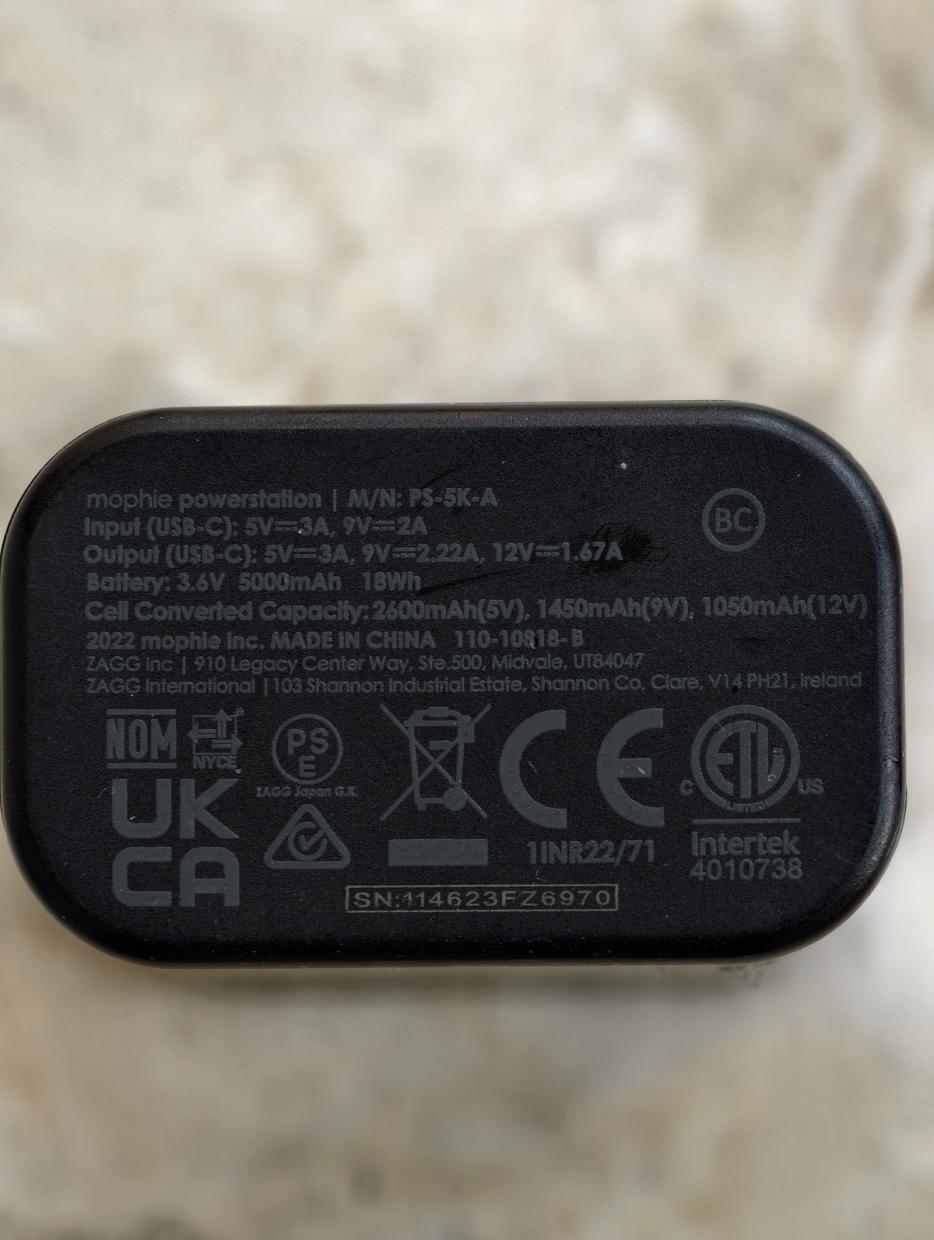
Do not rely on the brand. Major international brands sell different SKUs into different markets. The version sold in the US or Europe is frequently not the 3C-certified version, even from a manufacturer with a large Chinese presence, and even when the unit was physically made in China. Export models are not required to carry the mark.
Do not rely on your own country's certification. UL, CE and FCC are different schemes with different testing regimes. None of them is accepted as a substitute.
If you bought the power bank inside mainland China after August 2024 through a normal retail channel, it will carry the mark.
If yours is refused
The CAAC notice instructs airports to add staff at screening points to explain the rule, and to set up designated areas where passengers can voluntarily discard or temporarily store a non-compliant power bank, with a defined procedure. So the options below are not improvised favours — they are what the policy asks airports to provide.
That said, what is actually available to you varies, and you should plan for the worst case:
Shipping to a Chinese address. This is what we used at Shanghai. You provide an address and a mobile number, arrange it with staff, and pay the postage yourself. Allow around a week — ours took seven days.
This option is realistically limited to domestic departures. If you are flying out of China internationally, there is no onward Chinese address to send it to and no reason to expect this route to be offered.
Temporary storage at the airport. Holding periods and collection points differ by airport, and we have not confirmed a nationwide standard. If you expect to return through the same airport, ask at the screening point what the holding period is and where collection happens, and keep whatever receipt you are given. Do not assume you can retrieve it weeks later.
Surrender. Always available, and at a smaller airport it may be the only thing on offer.
Two cautions. Large hub airports are far more likely to have a functioning shipping or storage desk than a regional one — Shanghai, Beijing, Guangzhou and Shenzhen have volume and staff that Zhangjiajie or Dunhuang do not. And whichever option you take, it costs time you have not budgeted at a checkpoint you are trying to get through. Arriving with a compliant device is the only version of this that does not cost you anything.
What the rule does not cover
Arriving in China. Your inbound flight cleared security in another country. Nobody inspects a power bank on arrival, and there is no confiscation at immigration or customs over certification.
High-speed trains. China Railway does not require 3C certification for power banks. If your itinerary is train-based, this rule does not reach you at all — see our guide to travelling China by train for what railway security does check.
This creates a specific trap worth naming: a traveller who arrives with a non-compliant power bank, uses it happily for two weeks on trains, and then books a domestic flight home from Chengdu or a departure from Shanghai will meet the rule at the very end of the trip, with no time to deal with it.
Buying a compliant one in China
The simplest fix, and it is cheap.
Power banks sold through normal retail channels in mainland China have carried the 3C mark since August 2024. Convenience stores, electronics shops, airport shops and station kiosks all stock them. Buying on JD.com or Taobao and having it delivered to your hotel also works, if you have payment set up — see our guide to paying in China.
Rental power banks are an alternative worth knowing about. Shared charging stations sit in most restaurants, malls and stations, and are unlocked through a mini-programme inside Alipay or WeChat using the card you have already linked. You pay by the hour and drop the unit at any station. For a trip where you only need topping up between sights, this avoids the certification question entirely.
One thing to check before flying home: a power bank bought in China carries the 3C mark, so it clears Chinese security. Whether it is acceptable on your onward carrier is a separate question governed by your own country's rules and your airline's — the capacity limits are broadly similar internationally, but check rather than assume.