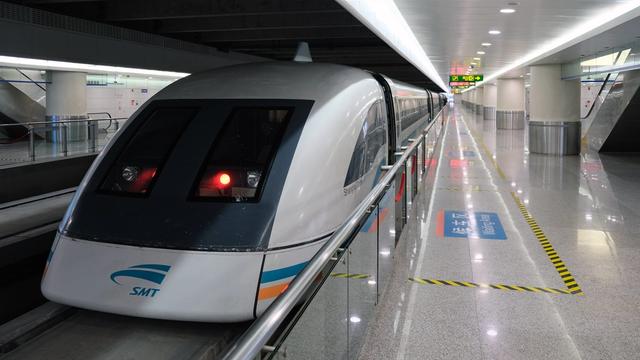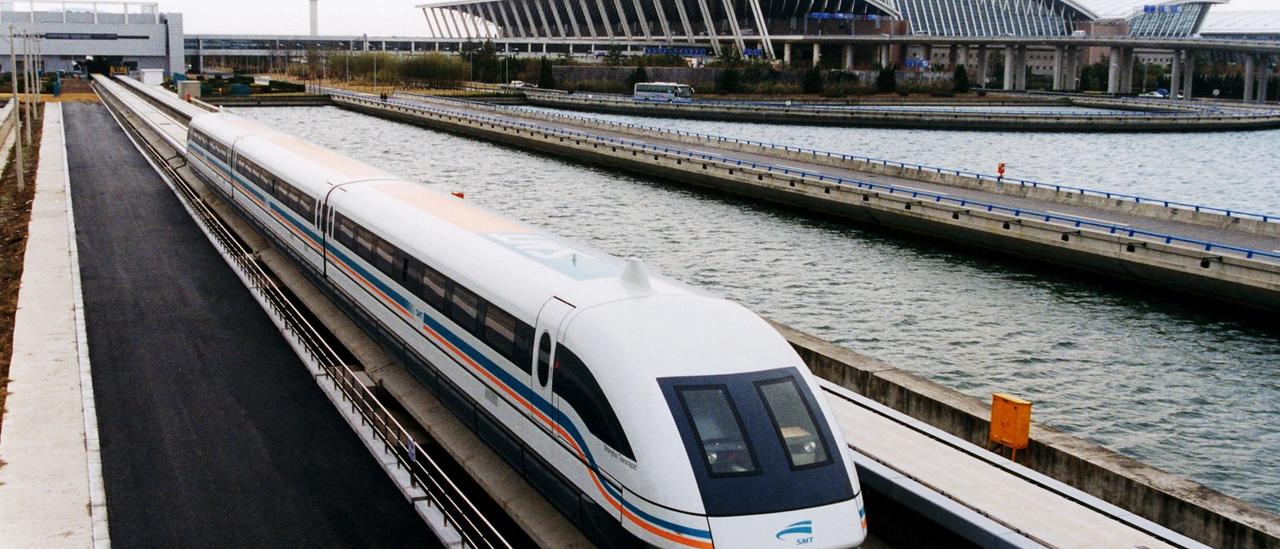
What it actually is
Two stations, one line, no intermediate stops:
Pudong Airport T1 & T2 station ↔ Longyang Road
The journey takes 7 minutes 20 seconds. Trains run roughly every 15 to 20 minutes depending on the hour. Top operating speed is 300 km/h — not the 430 km/h you will read almost everywhere else, and we come back to that below.
At the airport end, the Maglev station sits on the east side of the terminal complex, linked by a 300-metre covered walkway. At the city end, Longyang Road is an interchange with metro Lines 2, 7, 16 and 18.
If you are heading to Hongqiao Airport or Hongqiao Railway Station, this is not your train. You want the Airport Link Line, which leaves from the same part of Pudong Airport and runs to Hongqiao in about 40 minutes for ¥26. Following signs for the Maglev is, awkwardly, how you find it — the Airport Link entrance is next door.
Is it worth it?
The honest answer: the Maglev is an attraction that happens to be transport, not transport that happens to be fast. Judge it on that and you will be happy with it.
Here is the arithmetic nobody publishes. Pudong Airport to People's Square by metro Line 2, direct, no changes, is roughly 75 to 90 minutes and costs ¥7 to ¥8. Maglev plus Line 2 to the same place is roughly 45 to 55 minutes once you include the walk between the two stations and the wait for each train, and costs ¥45 to ¥55.
So you are buying about half an hour, for about six dollars, at the cost of one extra transfer with your luggage.
Whether that is a good trade depends almost entirely on which side of the river you are sleeping on.
| Your situation | Worth it? | Why |
|---|---|---|
| Staying in Pudong — Lujiazui, Century Park, near Longyang Road | ✅ Yes | Longyang Road is already most of the way there |
| Staying in Puxi — the Bund, Jing'an, Xintiandi, People's Square | ⚠️ Marginal | You save 30 minutes but add a transfer, and the Line 2 leg is the same either way |
| You want to have ridden a Maglev | ✅ Yes | This is a fine reason and you should not overthink it |
| Travelling alone with a cabin bag | ✅ Yes | The transfer is easy when you can carry everything |
| Two adults, two large suitcases | ❌ No | A taxi is ¥180–230 for the whole car and takes you to the door |
| Travelling with small children | ❌ No | The Longyang Road transfer is the wrong place to be shepherding anyone |
| Landing after 21:42 | ❌ No | The last train has gone — see the times below |
| Leaving Shanghai, bags already checked out of your hotel | ✅ Yes | Departing is the better direction; see below |
The direction matters more than most guides admit. Going city-to-airport, you are rested, you know where Longyang Road is, you have a fixed deadline, and the Maglev's reliability is worth real money. Going airport-to-city, you are eleven hours off a plane, you have never seen this station before, and the transfer is exactly the moment your patience runs out.
If you only ride it once, ride it on the way out.
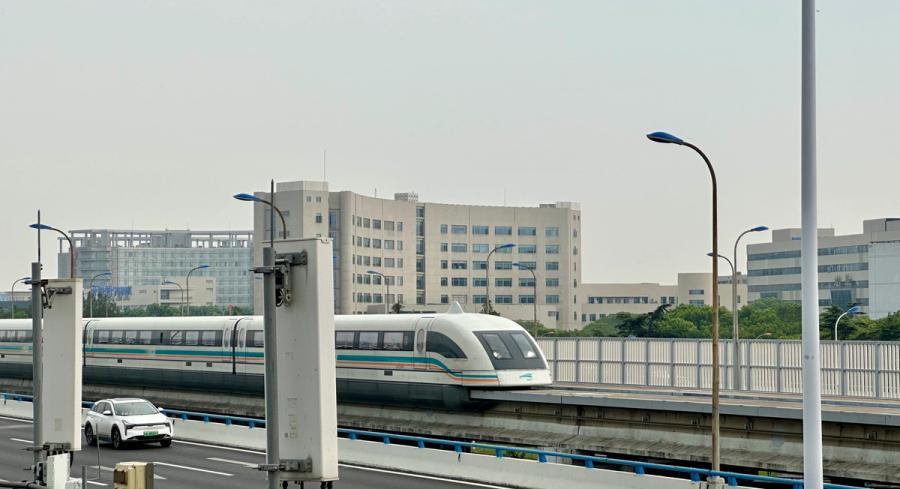
How to pay ¥40 instead of ¥50
Show your boarding pass or air ticket for the same day and the single fare drops 20%, from ¥50 to ¥40. One discounted ticket per air ticket.
This is real, official, and has been in place since 2004. It is also close to invisible in practice. The discount is noted in small print on the fare board and on a noticeboard some distance from the ticket machines. When Chinese journalists watched the queue at Longyang Road, most people tapped straight through the self-service machine's default ¥50 option and paid full price. Of five passengers approached who held a same-day air ticket, four went back to the staffed window and bought at ¥40 — all of them said they simply hadn't noticed.
So: use the staffed ticket window, not the machine, and have your boarding pass out. The ticket offices are on level 2 at both stations.
Two other routes to ¥40:
- A Shanghai Public Transport Card. Tap in with a physical card and the single fare is ¥40 automatically, no boarding pass needed.
- Concession holders. Honoured veterans, retired cadres and disabled passengers get the same 20% with the relevant Chinese ID. Not applicable to most visitors, but worth knowing if it applies to you.
One thing we have not been able to confirm: whether the Alipay-based Shanghai city travel code gets the same ¥40 rate as the physical card, or charges the full ¥50. The ¥40 figure is documented for the physical card specifically. If you are paying by QR code and the difference matters to you, check the fare before you tap.
Prices
| Ticket | Fare |
|---|---|
| Standard single | ¥50 |
| Standard single, with same-day air ticket | ¥40 |
| Standard single, tapping a Shanghai Public Transport Card | ¥40 |
| Standard return | ¥80 |
| VIP single | ¥100 |
| VIP return | ¥160 |
| Metro + Maglev combined ticket (one Maglev ride + metro day pass) | ¥55 |
| Metro + Maglev combined ticket (two Maglev rides + metro day pass) | ¥85 |
| 30-ride card | ¥900 |
Skip VIP. It is double the price for a slightly larger seat on a ride that lasts under eight minutes. The standard carriages are clean, quiet and rarely full outside peak hours.
The combined ticket is the quiet bargain if you are landing and then sightseeing the same day: ¥55 buys you the Maglev ride plus unlimited metro for 24 hours from first tap, which on a busy arrival day pays for itself.
Payment at the gates has widened considerably. Since June 2025 the Maglev has accepted foreign chip cards — UnionPay, Visa, Mastercard, American Express and JCB — along with phone-based mobile payments and digital RMB, tapped directly at the barrier. This is a trial programme and we would not assume it is permanent; if it matters to your arrival, have a backup. The ticket windows take cash and cards regardless.
Times and frequency
| Direction | First train | Last train |
|---|---|---|
| Longyang Road → Pudong Airport | 06:45 | 21:40 |
| Pudong Airport → Longyang Road | 07:02 | 21:42 |
Trains run roughly every 15 to 20 minutes, with the wider gap generally in the early morning and after 19:00. Published sources disagree about exactly where the 15-minute pattern gives way to the 20-minute one, and we have not been able to reconcile them against a current official timetable. Assume 20 minutes when you are planning, and treat anything better as a bonus.
Two hard deadlines to know. Doors close one minute before departure, and ticket checking stops five minutes before the last train. Aim to be at the gate ten minutes early, not five.
The last train out of the airport at 21:42 is the number that catches people. A flight landing at 20:30 will not make it — not after immigration, baggage and the walk. If you are landing in the evening, plan on Line 2, a taxi or Didi, and treat the Maglev as something you'll do on the way home instead.
How to ride it
From Pudong Airport
Follow signs for "Maglev" from arrivals. They are consistent and in English. The station is a 300-metre covered walk east of the terminals — flat, indoors, with travelators.
Buy at the staffed window on level 2, boarding pass in hand. This is the ¥40 step. The self-service machines default to ¥50 and will not prompt you.
Clear security. Yes, there is a security screening, the same bag-through-the-scanner routine as the metro. Budget five minutes.
Keep your ticket. You need it to get out at the other end. More on this below.
From Longyang Road
Come in on metro Line 2, 7, 16 or 18 and follow signs to the Maglev. The Maglev is not inside the metro's paid area — you exit the metro, then walk to a separate building.
Or arrive by taxi and be careful where you are dropped. If your driver stops on the north side of Longyang Road, you cannot cut straight through the Longyang building to the station; the metro's paid area occupies the whole ground floor. You have to walk west to Baiyang Road, turn left, turn left again at the next corner and come at the station from behind. That is three to four minutes empty-handed and comfortably over five with a suitcase, outdoors, in whatever weather Shanghai is having.
Tell the driver "磁浮龙阳路站" (Maglev Longyang Road station), not just "Longyang Road." It saves the walk.
The transfer nobody costs in
Longyang Road is China's first five-way interchange — Lines 2, 7, 16 and 18 plus the Maglev — and it is not an elegant one. The lines were built at different times and are strung together by long connecting passages. Line 7 in particular is a serious walk.
For Maglev passengers the relevant fact is that the Maglev is an out-of-station transfer. You leave the Maglev, exit through its own gates, walk to the metro building, and buy or tap a new fare. Signage has been improved in recent years — there are now overhead information screens along the passages showing walking distances and times to each line, and last-train times at night — but the walk itself has not got shorter.
Budget eight to twelve minutes from stepping off the Maglev to standing on a Line 2 platform, more if you are wrangling luggage or a family. That is the number to put into your arithmetic when you are deciding whether the eight-minute ride was worth ¥40.
Rules that catch people out
Your ticket is checked on the way out. Hold on to it. A lost ticket is treated as travelling without one.
On a return ticket, take the ticket back at the exit gate. You need the same ticket to get back in for the return leg. It is collected on your final exit.
Return tickets are valid for seven days. Singles are valid the day of purchase only.
Children under 120 cm travel free — one per adult. Above 120 cm they pay full fare. A child of 120 cm or under cannot travel unaccompanied.
The 20% air-ticket discount is one ticket per air ticket. A couple with two boarding passes gets two ¥40 tickets. One boarding pass does not cover two people.
Do not fold, punch or write on the ticket. A damaged ticket is treated as invalid. This sounds fussy and is enforced.
430 or 300 km/h?
You will see 430 km/h quoted in nearly every guide, on booking sites, and in the marketing. The train has run at 430. It does not run at 430 now.
Commercial operating speed was capped at 300 km/h in 2020 and Shanghai Airport's own transport page lists the maximum as 300 km/h today. There is no longer a faster mid-morning service, whatever older articles say.
We flag this not to be pedantic but because a surprising number of travellers get on expecting the number on the in-carriage display to climb past 400, and feel cheated when it levels off. Three hundred kilometres an hour is still faster than most high-speed rail on earth, and the ride is still remarkably smooth and quiet. Know the number going in and you'll enjoy it.