Which airport are you at?
| Pudong (PVG) | Hongqiao (SHA) | |
|---|---|---|
| Distance from centre | ~30 km east | ~13 km west |
| Metro by | Line 2 | Lines 2 and 10 |
| Typical metro time to People's Square | 75–90 min | 30–40 min |
| Typical taxi fare to the centre | ¥180–230 | ¥70–100 |
| Terminals | T1, T2, satellite hall | T1, T2 |
| Maglev | ✅ | ❌ |
| Airport Link Line | ✅ | ✅ (T2 only) |
| Attached to a high-speed rail hub | ❌ | ✅ |
| Handles | Most long-haul international | Mostly domestic and short regional |
If you are transiting between the two, skip to the Airport Link Line below. It is 40 minutes and ¥26, and it is not the same thing as the Maglev.
Choose by when you land and what you're carrying
Route choice in Shanghai is not really about speed. It is about how much of your energy you have left, and how many times you are willing to lift a suitcase.
| Your situation | Landing at Pudong | Landing at Hongqiao |
|---|---|---|
| Daytime, cabin bag only | Metro Line 2 | Metro Line 10 or 2 |
| Daytime, one large case, staying in Pudong | Maglev, then Line 2 | Metro |
| Daytime, one large case, staying in Puxi | Metro Line 2 direct | Metro |
| Two or more people with checked bags | Taxi | Taxi |
| Travelling with young children | Taxi | Taxi |
| Landing after 22:00 | Taxi or Didi | Taxi or Didi |
| Landing after 23:00 | Taxi, or the night bus | Taxi |
| Heading straight to Suzhou or Hangzhou | Airport Link Line to Hongqiao Railway Station | Walk to Hongqiao Railway Station |
| Heading to Disneyland | Airport Link Line | Metro, changing to Line 11 |
A note on cost that first-time visitors consistently get wrong. A Shanghai taxi from Pudong to the Bund runs ¥180–230 for the whole car, not per person. Split three ways that is roughly ¥70 each, against ¥7 on the metro — a real difference, but not the gulf that "taxi versus metro" implies in most Western cities. For a group with luggage, it is usually the right call.
Pudong Airport to the city
Metro Line 2
The default, and for most people the right one. Line 2 runs from Pudong Airport clear across the city to Xujing East, calling at Longyang Road, Lujiazui, Nanjing East Road, People's Square, Nanjing West Road, Jing'an Temple, Hongqiao Airport T2 and Hongqiao Railway Station. No changes, ¥7–8, roughly 75 to 90 minutes to People's Square.
The station sits between T1 and T2, about 200 metres from each, signposted in English from both arrivals halls.
The Guanglan Road question. For years, passengers had to change trains at Guanglan Road because the eastern section ran shorter four-car trains. That ended in 2019 — eight-car trains now run through to the airport for most of the operating day. The exception is the weekday morning peak, when mixed operation still runs on the eastern extension.
In practice this means: look at the destination on the front of the train and on the platform display. If it says Pudong International Airport, stay on it. If it terminates at Guanglan Road, you can change at any station before Guanglan Road onto a through train — which is easier than getting off at Guanglan Road itself, where the connection may mean crossing to the opposite platform with your bags.
Metro operating hours from the airport run roughly 06:00 to 22:00, with slightly different first and last times in each direction. Shanghai adjusts its timetables more often than most systems, so check the current times in the Metro Metropolitan app rather than trusting any figure printed in a guide, this one included.
The Maglev
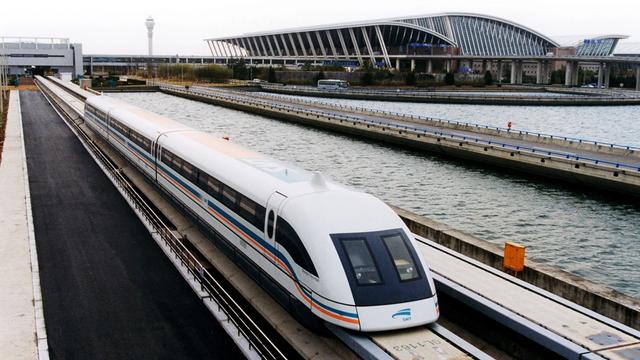
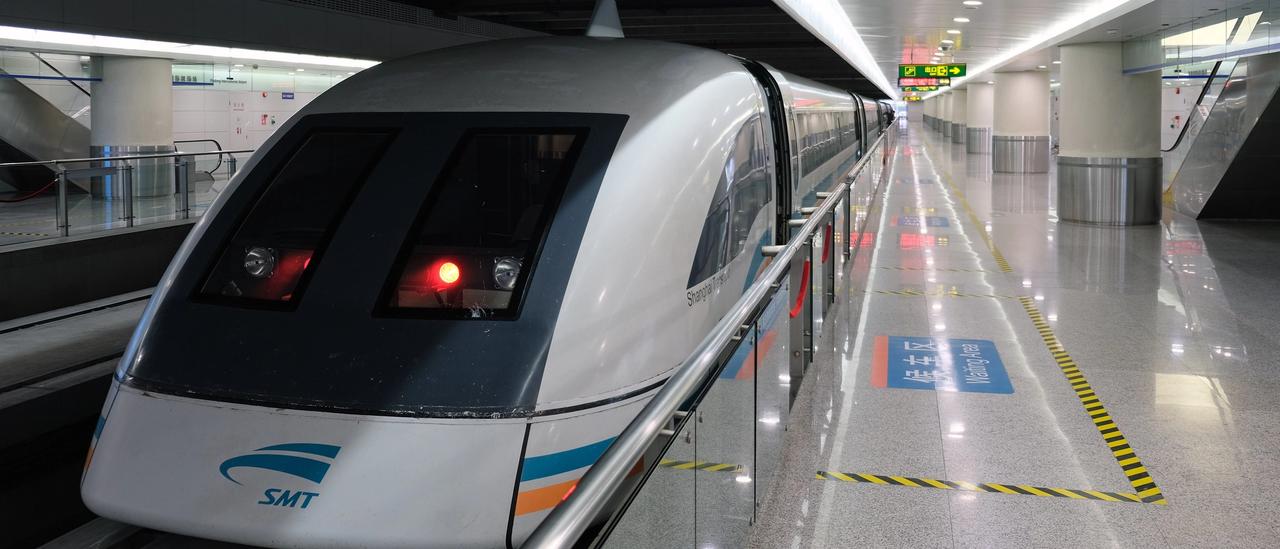
Eight minutes to Longyang Road for ¥50, or ¥40 if you show a same-day boarding pass at the staffed ticket window. Last train out of the airport is 21:42.
It is the fastest way out of the airport and it is a genuinely good experience. It is not, however, a way into central Shanghai — Longyang Road is a metro interchange in eastern Pudong, and you will still have 20 to 30 minutes on Line 2 after an out-of-station transfer of eight to twelve minutes.
Worth it if you are staying in Pudong or travelling light. Marginal if you are heading to the Bund with two suitcases. → Full Maglev guide: tickets, prices and whether it's worth it
Taxi
Metered, regulated and straightforward. Follow signs for "Taxi" from arrivals and join the official queue. Expect ¥180–230 to central Shanghai and 45 to 70 minutes depending on traffic and which side of the river you're crossing to.
Shanghai's meter starts at ¥14 for standard cabs and ¥16 for electric ones, covering the first three kilometres, with a surcharge of around 30% between 23:00 and 05:00. Published per-kilometre rates beyond that disagree with each other across sources, so treat the ¥180–230 range as the useful number and the meter as the authority.
Ignore anyone who approaches you. People work the walkway between arrivals and the taxi rank offering rides — typically pitched as cheaper than a taxi, and usually more than a ride-hailing app would cost. There is no meter, no receipt and no recourse if something goes wrong. Chinese consumer reporting has documented this at Pudong repeatedly. The official queue moves faster than it looks; taxi supply at Pudong has been actively boosted in recent years and waits of five to ten minutes are normal.
Ask for a receipt (发票) when you pay. It carries the taxi number and is what makes lost property recoverable.
Didi and ride-hailing
Didi has an English interface and takes foreign cards. Fares run a little under a metered taxi outside surge periods.
The problem is not the app. It is finding the car. At Pudong, ride-hailing pickup is inside the P2 car park, level B1, where there are around twenty numbered waiting bays. Your app can pin you down to the specific bay.
What makes this hard is that the overhead signage in the arrivals hall lists taxis, the Maglev, the metro, airport buses and long-distance coaches — and not ride-hailing. Chinese journalists who tested the route found the only pointers were free-standing blue "traffic information" boards, where ride-hailing appeared fifth on the list. Once you are heading in the right direction the signs are frequent, roughly every ten metres.
So: head for P2, go down to B1, then match your bay number to the app. If your driver cannot find you, send them the bay number rather than trying to describe where you are standing.
Airport buses
Buses still run from both terminals to various points in the city, and they are cheaper than a taxi with more luggage room than the metro. But the network was cut on 15 November 2025, when Airport Bus Lines 1 and 9 were both discontinued in both directions. Line 1 was the Pudong–Hongqiao connection, which a great many English-language guides still recommend. It no longer exists; the Airport Link Line replaced it.
Several other lines continue to operate, serving destinations including Jing'an Temple, Shanghai Railway Station, Hongkou Football Stadium and Shanghai South Railway Station. Timetables and fares change often enough that we are not going to print a list that will be wrong within months. Check the departures board at the terminal, or Shanghai Airport's own transport page, on the day.
Long-distance coaches to Suzhou, Hangzhou, Kunshan, Jiaxing, Nanjing and elsewhere leave from the coach station on level 2 of T1 — useful if the Yangtze Delta, not Shanghai, is your actual destination.
After the last train
The metro stops around 22:00, the Maglev at 21:42, and the Airport Link Line at 22:15. After that:
Taxi or Didi. Both operate all night. Expect the 30% night surcharge after 23:00.
The night bus (守航夜宵线) runs after 23:00 from T1 and T2, calling at Longyang Road, Century Avenue metro, Yan'an Road East near People's Square, Jing'an Temple and Yan'an Road West, and terminating at Hongqiao Hub East Transport Centre. It runs one direction only, and you can only board at the two terminals — every stop after that is drop-off. Fares are around ¥30. Intervals stretch to 45 minutes at the far end of the night.
For a first arrival in China, at midnight, in a language you don't read: take the taxi. This is not the night to save ¥150.
Hongqiao Airport to the city
Hongqiao is the easier arrival by a wide margin. It is closer, smaller, and the metro is genuinely quick.
Metro
Terminal 1 is served by Line 10. Terminal 2 is served by Lines 2 and 10. Both stations are inside the terminals, signposted in English, one level down.
- Line 10 runs to Nanjing East Road, Yuyuan Garden and Wujiaochang, and also connects the two terminals with Hongqiao Railway Station.
- Line 2 runs to Jing'an Temple, Nanjing West Road, People's Square, Lujiazui and eventually Pudong Airport.
Fares are ¥5–7 and the ride to the central stations is 30 to 40 minutes. Services run from roughly 05:30 to 23:00.
One thing to watch on Line 10. The line has a branch, and trains do not all go to the same place. Coming back to Terminal 1 later in your trip, make sure you board a train showing Hongqiao Railway Station as its destination, not the branch terminus. Getting this wrong on the way to a flight is a bad half hour.
Note that Line 17 serves Hongqiao Railway Station, not the airport terminals. Guides that list it as an airport line are being loose with the geography.
Taxi
T1: the rank is outside gate 1 of the arrivals hall. T2: outside gate 4. Fares to central Shanghai run ¥70–100, journey time 30 to 50 minutes.
Queues at Hongqiao can be long at peak times — the hub serves the airport and the railway station together, and a delayed batch of high-speed trains empties into the same rank. If the line is snaking, the metro is right there and will beat it.
Ride-hailing
This is the one part of Hongqiao that is genuinely confusing, and worth reading before you land.
Ride-hailing pickup is in the P6 car park. The car park's levels have animal names rather than numbers, and the mismatch is where people come unstuck: apps have been observed pinning passengers to the "Camel level" (B1) while the actual pickup bays are on 2F, the "Giraffe level." Travellers have reported waiting on the wrong level, drivers circling to find them, and being charged the ¥10 fee that applies when a car exceeds twenty minutes inside the airport.
Compounding this, P6's level 2 has been undergoing a traffic-flow reconstruction since 12 March 2026, with access restricted during the works. We have not been able to confirm the current arrangement against an on-the-ground source.
Practical advice: when your driver is assigned, call or message them and agree a level by name, not by number. If you are tired or it is late, the taxi rank outside gate 1 or gate 4 removes the entire problem for maybe ¥20 more.
The Hongqiao advantage
Hongqiao Airport, Hongqiao Railway Station and the metro network sit in one connected complex. From Terminal 2 you can walk to the high-speed rail station — officially about five minutes, realistically ten to fifteen with luggage — and be on a train to Suzhou in 25 to 35 minutes, Hangzhou in 50 to 70, or Nanjing in around 90.
If your trip is really a Yangtze Delta trip with a night or two in Shanghai, flying into Hongqiao rather than Pudong is worth paying for.
One operational note if you are departing: since 28 October 2025, domestic flights at Hongqiao close check-in 30 minutes before departure for passengers without checked bags. Some airlines have gone further on specific routes. Do not treat this as licence to arrive at the last minute, but it does mean a tight connection is more survivable than it used to be.
The Airport Link Line
This is the piece almost every English-language guide either omits or gets wrong, and it changes several answers.
What it is: a suburban rail line, opened 27 December 2024, running east–west across the south of the city at 160 km/h. It connects Hongqiao Airport T2 to Pudong Airport T1 & T2 in about 40 minutes.
Seven stations, in order: Hongqiao Airport T2 — Zhongchun Road — Jinghong Road — South Sanlin — East Kangqiao — Shanghai International Resort — Pudong Airport T1 & T2.
Fares start at ¥4 and the full end-to-end journey is ¥26.
Times, as revised on 1 April 2026: the first train from Hongqiao T2 now leaves at 05:45, and the last train from Pudong T1 & T2 leaves at 22:15. Trains run every 15 minutes. Note that a lot of published information still shows the pre-April figures of 06:00 and 22:00 — including some otherwise reliable sources.
Read that station list again, because it explains what the line is for. It does not stop at People's Square, Nanjing Road, the Bund or Lujiazui. The Airport Link Line does not go downtown. It is for three things:
Getting between the two airports — 40 minutes, against 90 or more on metro Line 2.
Reaching Hongqiao Railway Station from Pudong Airport, and therefore reaching Suzhou, Hangzhou and the rest of eastern China without going through the city.
Reaching the Disney resort district, via Shanghai International Resort station. Confirm the walk or shuttle to your specific hotel or park gate before you rely on this — the station serves the resort area, and "in the resort district" is not the same as "at the gate."
Finding it at Pudong Airport is oddly hard. Travellers report no signage for the Airport Link Line in the arrivals area at all — the way to find it is to follow signs for the Maglev, and the large blue Airport Link sign is next to the Maglev entrance. Ticket machines there sell Airport Link tickets in a separate grey-coloured section, and accept cash and cards.
Two smaller things worth knowing. Trains alternate between four-car and eight-car formations, so check the platform door markings before you position yourself. And at Zhongchun Road you can transfer to metro Line 9 without leaving the station — but transfers at the other interchange stations require exiting and buying a new ticket, with no continuous fare calculation.
Paying for any of this
Sort this out before you fly. It is the single most common reason a Shanghai arrival goes badly, and it is entirely preventable.
Alipay or WeChat Pay, with a foreign card linked. Both accept international Visa and Mastercard, both register with a foreign phone number, and both include a transit QR code that works on the metro, buses and the Airport Link Line. Set up at home on your own wifi, complete the identity verification, and make one small test transaction. Skipping verification caps your spending for the whole trip.
Do not run a VPN while paying. Alipay's fraud systems flag VPN-routed traffic and can refuse the transaction outright. If you need a VPN for other things, turn it off before you tap.
Ignore anyone at the airport offering to set up your payment app for a fee. This is a known hustle. The apps are free and the setup takes ten minutes.
Beyond the apps:
- Single-journey tickets from machines at any metro station, cash or card.
- Foreign bank cards at station service centres. Every metro station service centre has a card terminal that will sell you single tickets, one-day and three-day passes, and at some stations the combined metro–Maglev tickets. Visa, Mastercard, Amex, Discover, Diners and JCB.
- The Metro Metropolitan app, which foreign visitors can register with a passport, Hong Kong/Macao permit or Taiwan permit, then pay after travelling.
- A physical Shanghai Public Transport Card, bought and topped up with cash at station counters — the fallback if you have no working smartphone, and the way to get the ¥40 Maglev fare without a boarding pass.
One thing that does not reliably work: tapping a foreign contactless card directly on a normal metro gate. The Maglev accepts foreign chip cards at its gates under a trial that began in June 2025; the metro proper does not. Do not plan your arrival around it.
Three things that will go wrong
You will miss the last train and not know it. Three different last-train times — Maglev 21:42, metro around 22:00, Airport Link Line 22:15 — and a delayed flight puts you outside all of them. Check your inbound arrival time against these before you leave home, not after you clear immigration.
You will not find your Didi. Both airports put ride-hailing pickup inside multi-level car parks with poor signage from arrivals. Know the bay or level before you start walking, and call the driver rather than trying to find them by looking around.
Someone will offer you a ride. In the walkway to the taxi rank at Pudong, most likely. Politely decline and keep walking to the official queue.
What's changing
Two projects will redraw this within a couple of years.
Shanghai East Railway Station, part of the Eastern Hub next to Pudong Airport, is scheduled to enter service on 1 July 2027. It will put high-speed rail directly at Pudong Airport and connect through the Airport Link Line to Hongqiao — which would remove the main reason to cross the city at all.
Pudong Terminal 3 is scheduled to be ready in 2028, designed for 50 million passengers a year and already allocated its own station on the Airport Link Line.
Neither affects a trip taken now. Both mean any guide to this subject, including this one, has a shelf life.