
Can foreigners stay in any hotel in China?
In principle, yes. Chinese authorities have made clear that accommodation providers should not reject foreign guests merely because they lack a so-called “foreign guest qualification.”
In July 2024, China’s Ministry of Commerce and six other departments instructed local authorities and booking platforms not to restrict accommodation providers from receiving international guests based on qualification requirements. The notice also addressed outdated “no foreign guests” listings, staff training and registration procedures. See the official Ministry of Commerce announcement.
A confirmed reservation still does not guarantee check-in. A hotel may have an ordinary reason to refuse a guest, such as an invalid identity document or no available room, and some front desks have not caught up with the national policy.

A short policy timeline
| Date | Development |
|---|---|
| January 2003 | Beijing removed its citywide restriction on foreign guests staying only at designated hotels, an early step away from the old designated-hotel system. |
| May 2024 | The Ministry of Public Security, Ministry of Commerce and National Immigration Administration stated that hotels must not reject international guests on the ground that they lack “foreign-related qualifications.” |
| July 2024 | Seven national departments issued measures intended to make accommodation easier for international visitors and improve registration, platform information and staff training. |
| March 20, 2026 | The National Immigration Administration began an online registration pilot for foreigners staying outside hotels in seven provincial-level regions. |
The 2003 Beijing change and the practical reasons for later refusals are summarized by the Xinjiang Department of Culture and Tourism. The 2026 pilot is explained by the National Immigration Administration.
Why do some Chinese hotels still refuse foreign guests?
The gap between national policy and front-desk practice is usually operational. Registering a passport requires different information from scanning a Chinese identity card, and staff at a hotel that rarely receives international visitors may not know the procedure.
Common reasons for refusal include:
- The front-desk employee has never registered a foreign passport.
- The hotel is worried about entering the information incorrectly.
- Staff members cannot communicate confidently in English.
- A booking-platform label or an internal hotel policy has not been updated.
- A small-town or remote-area property has little experience with international travelers.
These problems are less common at international chains and larger hotels in major tourist cities, but a brand or platform listing is still a signal rather than a guarantee.
Option 1: Stay in a hotel
For most first-time visitors, a regular hotel is the simplest choice. You present your passport at reception, and the hotel handles the accommodation registration.
How to find a suitable hotel
Trip.com: the best starting point for most foreign visitors
Trip.com is usually the most practical place to begin. Its parent group began as Ctrip in China in 1999, and the platform generally offers a broader selection of Chinese hotels—including local and lower-priced properties—than its international competitors. It combines that domestic reach with multilingual booking and 24-hour support. Trip.com directs customers who cannot check in because of a booking or supplier problem to contact its support team. See its official company profile and customer service page.
Most properties presented to international users can accommodate foreign travelers, but a Trip.com listing is not a legal guarantee that every front-desk employee will know what to do.
Booking.com and Agoda: useful international alternatives
Booking.com and Agoda are familiar alternatives. They may show fewer independent hotels in Chinese counties and small cities, but listed properties are often more accustomed to overseas bookings. This is an indicator, not proof: hotels also distribute rooms through groups, agencies and inventory partners.
| Platform | Main advantage in China | Main limitation |
|---|---|---|
| Trip.com | Broad Chinese hotel selection, international interface and support familiar with China bookings | A listing cannot guarantee the procedure at every individual front desk |
| Booking.com | Familiar interface and many internationally oriented properties | Fewer small local properties in many parts of China |
| Agoda | Useful alternative for travelers who already use it in Asia | Domestic selection may be thinner than Trip.com, especially away from major destinations |
Confirm before traveling to a small or remote destination
If you are visiting a county, a small city or a remote scenic area, contact the hotel in advance regardless of which platform you use. This matters most when you will arrive late or when there are few alternative properties nearby.
Do not ask only whether the reservation is confirmed. Say that you will check in with a foreign passport and ask whether the front desk can register a foreign guest:
English: I will be checking in with a foreign passport. Can your front desk register foreign guests?
Chinese: 我会使用外国护照入住,请问你们前台可以办理外国人住宿登记吗?
Which types of hotels are usually easiest?
| Accommodation type | Examples | Practical assessment |
|---|---|---|
| International hotel chains | Marriott, Hilton, Hyatt, IHG and Accor brands | Usually experienced with foreign passports and international guests |
| Large Chinese hotel groups | H World, Jin Jiang, BTG Homeinns and similar groups | Experience varies by brand, city and individual branch |
| Higher-end independent Chinese hotels | Established four- and five-star properties | Often have more registration and language experience |
| Youth hostels | Properly operated hostels in major tourist destinations | Often used to international travelers, but confirm the individual property |
| Serviced apartment hotels | Properties with a staffed reception desk and hotel-style check-in | Suitable when the operator confirms that it registers foreign passports |
This is not a list of legally approved “foreigner hotels.” It only identifies properties more likely to have experienced staff; no brand can guarantee every branch.
Who completes the registration at a hotel?
The hotel does. Bring your original valid passport or another identity document accepted under Chinese rules and give it to the front desk during check-in. The hotel records your information and reports the stay to the local public security authority.
You do not need to visit a police station after checking into a hotel. If you move to another hotel, the new hotel registers the new stay.
Option 2: Stay with friends or in other non-hotel accommodation
Non-hotel accommodation includes a friend’s home, a relative’s home, a privately rented apartment, a private short-term rental, and any homestay or serviced apartment that does not register you through a hotel front desk.
If you stay in one of these places, discuss registration with the host or landlord before arrival. Under Article 39, either the foreign guest or the person providing the accommodation must complete the registration within 24 hours after the guest arrives at the address.
The law does not require both people to appear together in every case. In practice, going with the host is often easiest because the police may need the host’s identity and property documents.
The U.S. Department of State’s China travel information also tells travelers to register at their hotel or residence within 24 hours and to register again at each new location.
How to register at a local police station
Outside an area that provides an online option, contact the police station responsible for the accommodation address. The exact documents can vary locally, but commonly requested materials include:
- The foreign guest’s original valid passport;
- The host’s identity document;
- A property ownership certificate, lease or other proof of the address;
- Contact details for the guest and host; and
- Any additional document requested by the local office.
The foreign guest or host can call the National Immigration Administration’s 12367 service hotline before visiting if the local procedure is unclear.
Online registration through NIA 12367
Since March 20, 2026, online registration for non-hotel accommodation has been available as a pilot in seven provincial-level regions:
- Hebei;
- Liaoning;
- Zhejiang;
- Hubei;
- Guangxi;
- Chongqing; and
- Sichuan.
The available channels are the National Immigration Administration Government Service Platform website, the NIA 12367 app, and the NIA 12367 mini programs in WeChat and Alipay. Online and in-person registration have the same legal effect.
For a first registration at an address, the host should assist. A foreign guest may register independently when registering again at the same address through the platform or when staying in a home owned by the guest or the guest’s spouse. See the National Immigration Administration’s March 20, 2026 policy interpretation.
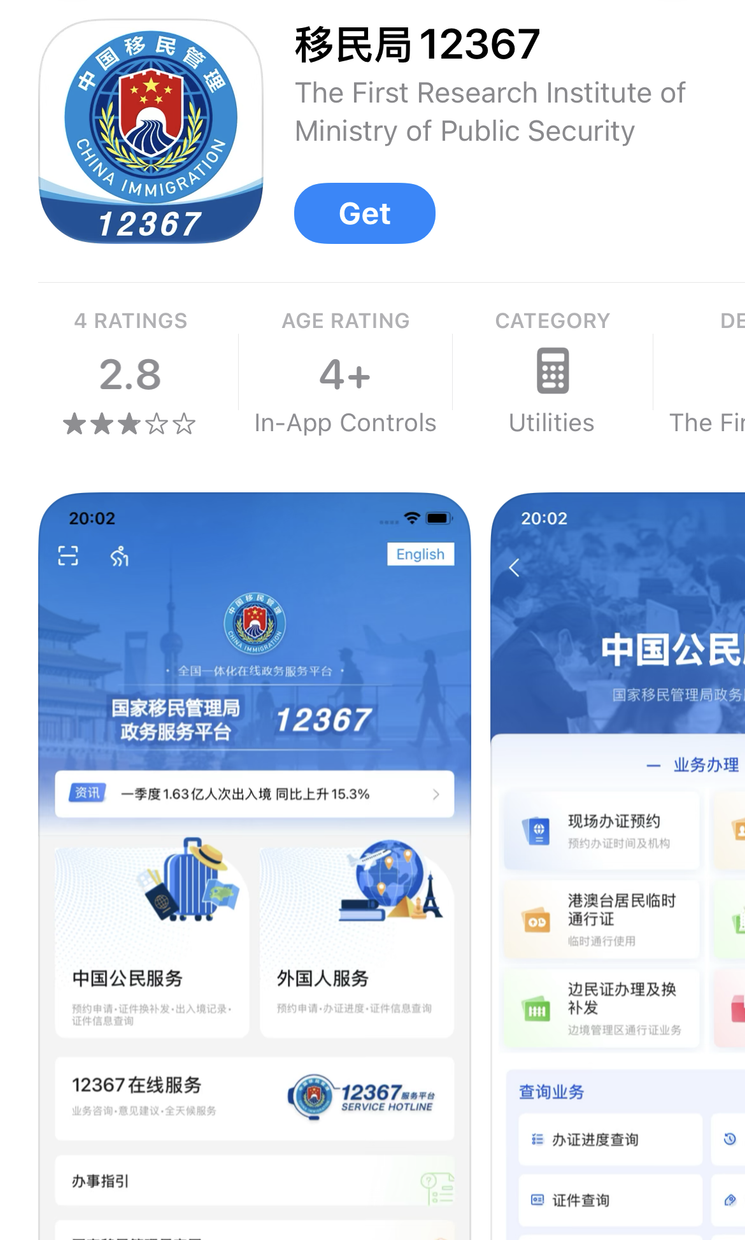
Step 1: Download or open NIA 12367
Search for NIA 12367 in your mobile app store. You can also use the NIA 12367 mini program in WeChat or Alipay.
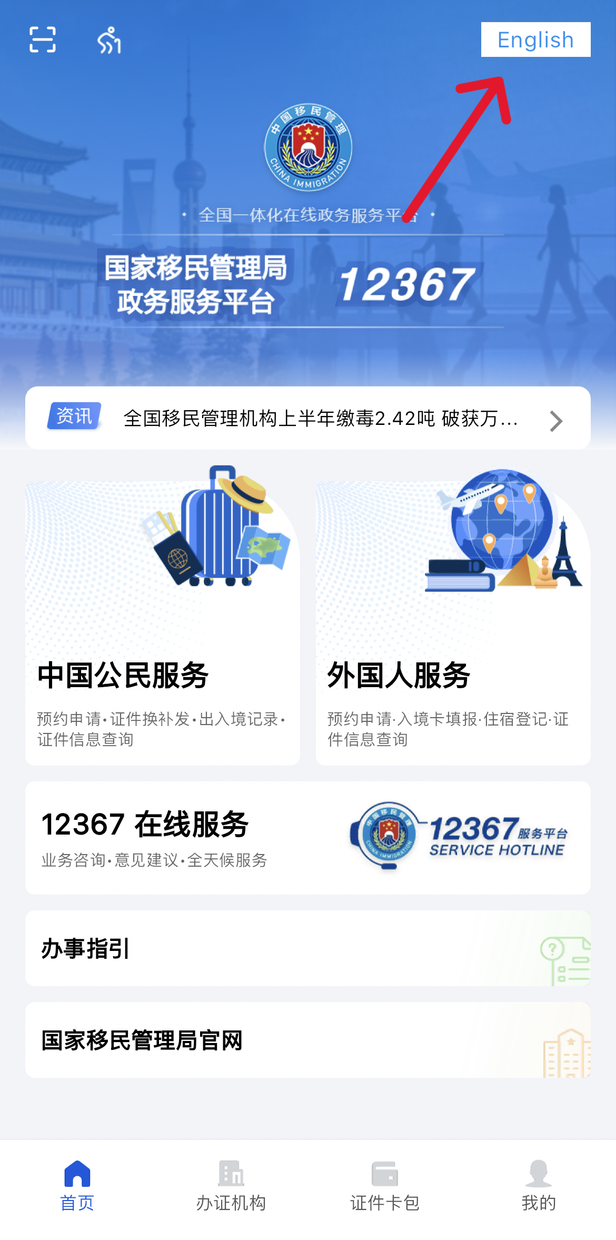
Step 2: Switch the interface to English
Open the language settings and select English before beginning the application.
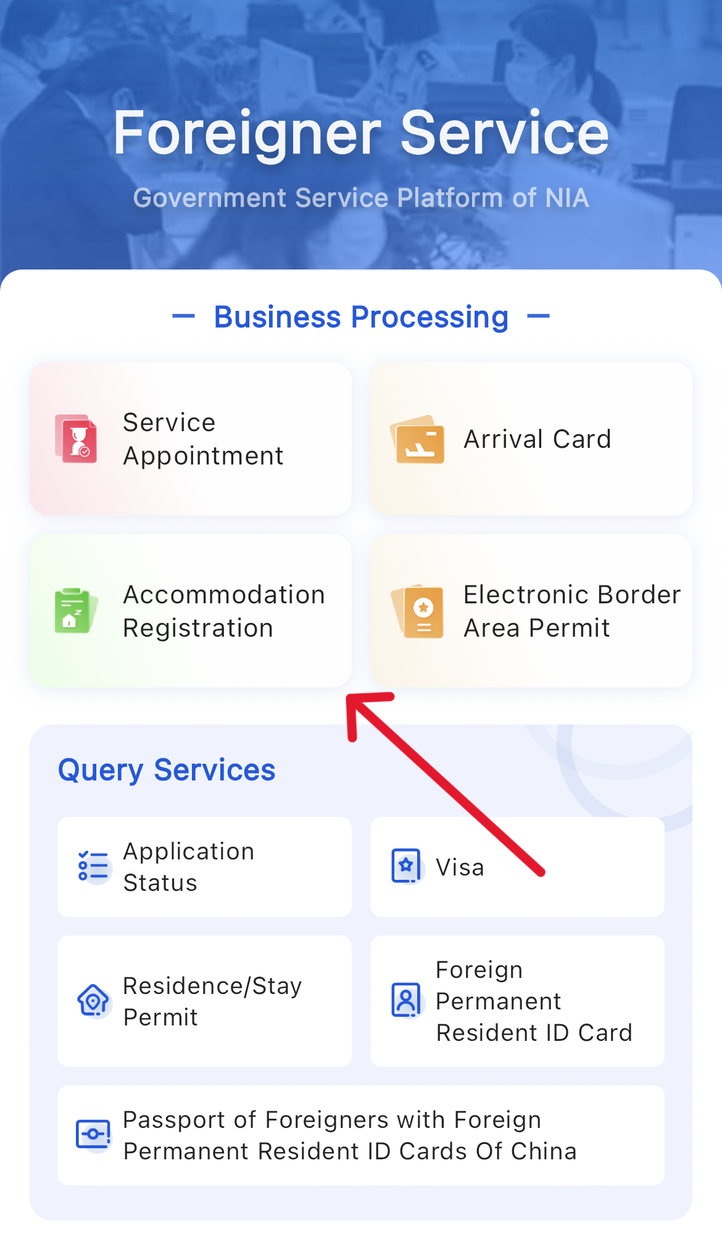
Step 3: Open Accommodation Registration
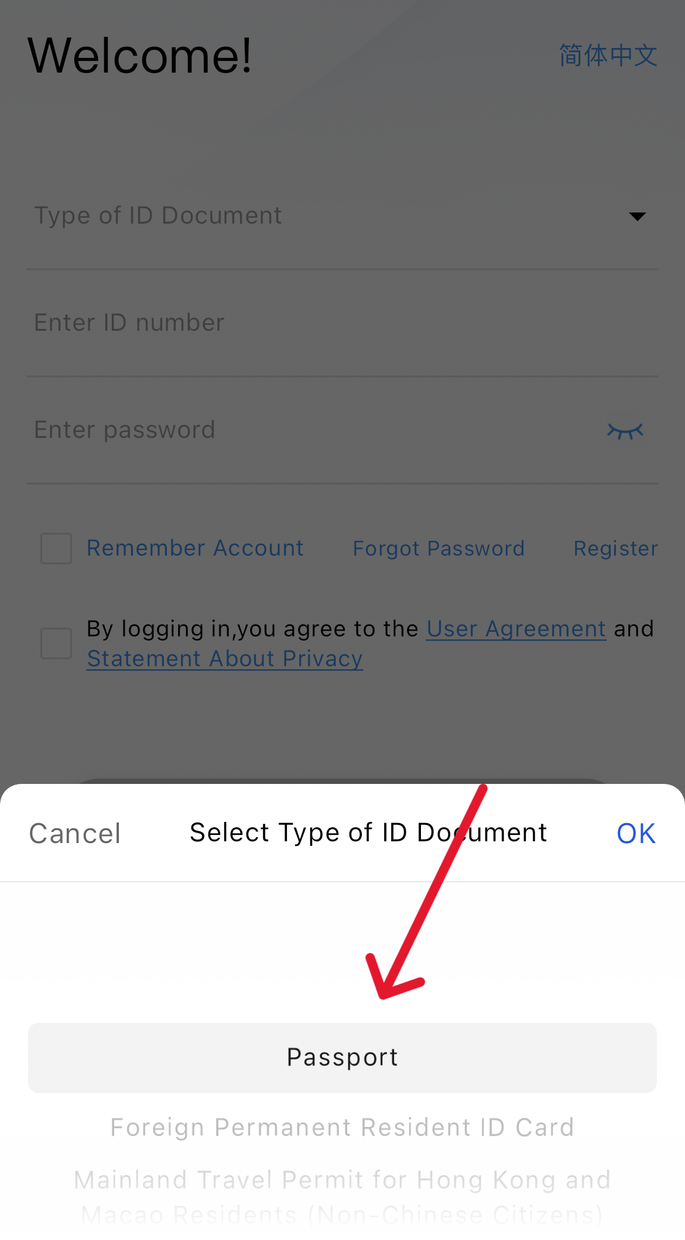
Enter Foreigner Services, choose Accommodation Registration, and select the relevant passport option. Register an account and complete the identity-verification prompts.
Step 4: Submit and save the registration record
Follow the prompts to enter the guest, host and accommodation information and upload the requested documents. After submission, use Registration Record Inquiry to view the result. Save a screenshot or electronic copy of the accepted record.
If online registration is unavailable, fails to produce an accepted record or raises questions, call 12367 or contact the local police station before the 24-hour period expires.
What about Airbnb and other private rentals?
Airbnb removed its mainland China domestic listings in July 2022. Travelers may still find private rentals through Chinese platforms or other channels, but the platform used does not determine the registration responsibility.
Before paying for a private rental, ask whether the operator will register your passport as a hotel guest. If the answer is no, arrange the non-hotel registration with the host within 24 hours.
Hotel, serviced apartment, homestay or private home: who registers you?

| Where you stay | Who normally handles the registration? |
|---|---|
| Regular hotel | The hotel front desk |
| Properly operated youth hostel | The hostel front desk |
| Serviced apartment operating as a hotel | The property’s reception or operator |
| Friend’s or relative’s home | The foreign guest or the host |
| Private rental apartment | The foreign guest or the landlord/host |
| Private homestay or short-term rental | The foreign guest or host, unless the operator explicitly completes hotel registration |
The decisive question is not what the property calls itself. Ask:
Will this property register my passport as a hotel guest and report my stay to the local public security authority?
If the answer is yes, the property handles the registration. If the answer is no, treat the stay as non-hotel accommodation.
Do you need a Temporary Accommodation Registration Form?
Hotels increasingly keep accommodation records electronically, so tourists may not automatically receive a paper form. Save any paper or digital record you receive. National Immigration Administration guidance notes that valid accommodation registration may be required for a visa extension. Travelers planning immigration procedures should ask how to obtain proof and retain their private-address registration records.
The simplest way to remember the rule
If you stay in a hotel, show the front desk your passport and let the hotel register you.
If you stay anywhere that does not register you as a hotel guest—including a friend’s home, private rental or private homestay—agree on the process with the host and complete the registration within 24 hours. In the seven pilot regions, you may be able to do it online through NIA 12367; elsewhere, contact the local police station or call 12367 for guidance.