
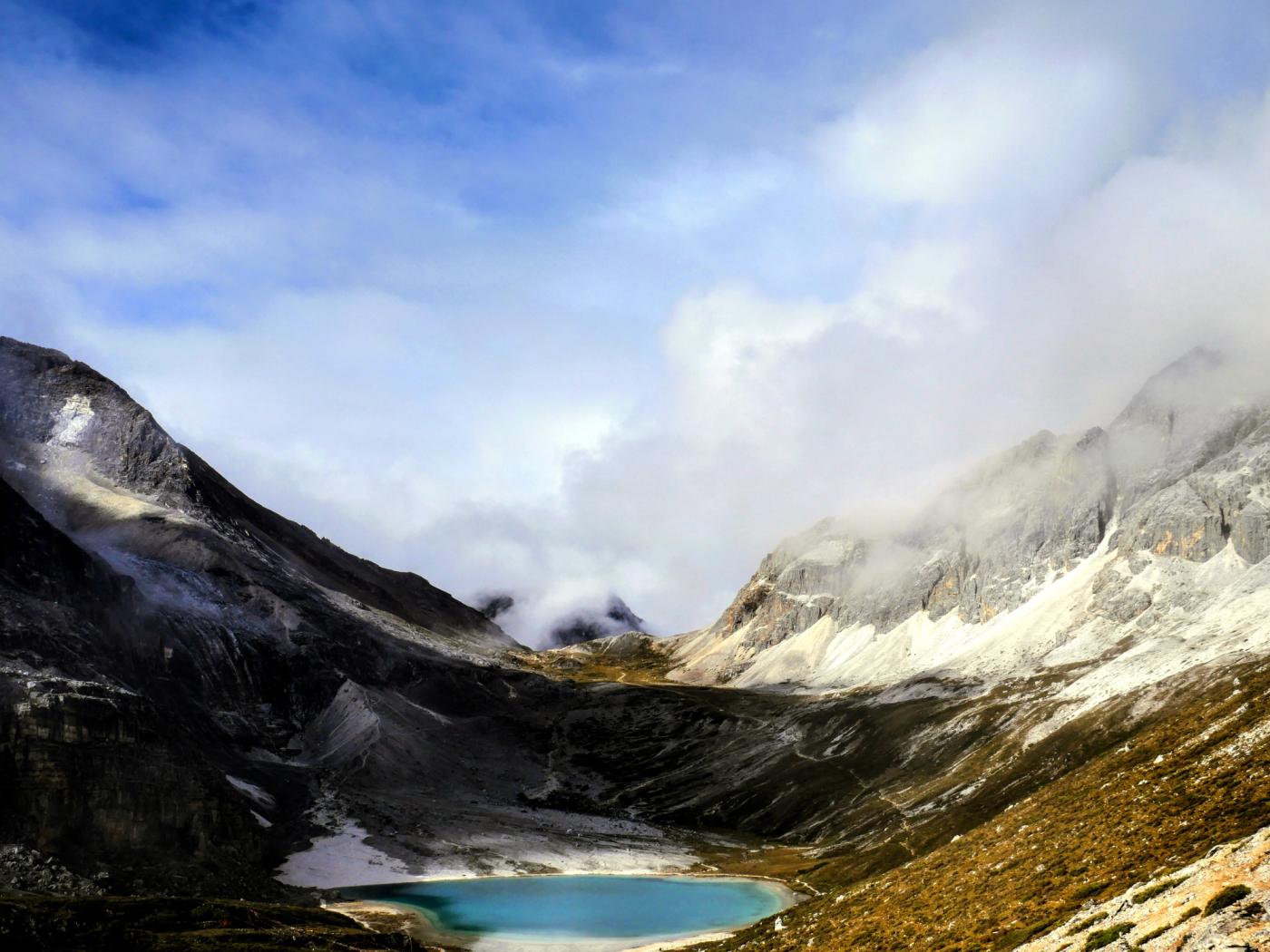
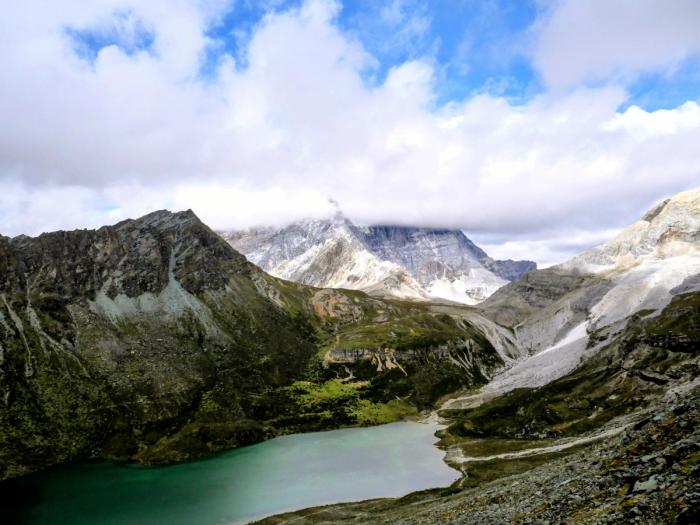
Daocheng Yading's real draw isn't the overused "three sacred peaks" label. It's the vertical range: this is one of the very few places in China where a single day's walking takes you from about 2,900 metres to 4,700 metres — river-valley forest, alpine meadow, glacial lakes and bare snow peaks stacked onto one trail instead of spread across hundreds of kilometres. That compression is the reward, and the altitude is the price. In May 2025 a visitor died of altitude sickness inside the reserve, so treat the numbers below as a safety plan, not trivia. Come acclimatised and Yading pays you back; arrive unprepared and it can hurt you.
This guide is built to help you decide and plan: which route to walk, how to handle the altitude, where to sleep, what it actually costs, and how to route the wider trip.
Long route or short route — the one decision that matters
The reserve really has only two walking routes, and they split at Chonggu Temple (冲古寺). Get this choice right and the rest of the day falls into place.
The short route runs Chonggu Temple to Pearl Lake (卓玛拉措 / Zhuoma La Co): about 3 km round trip at 3,900–4,100 metres, two to three hours on a gentle stone path. Pearl Lake is the classic spot for the mirror reflection of Xiannairi (仙乃日) — on a still, clear day the whole peak sits on the water.
The long route runs Chonggu Temple to Luorong Pasture (洛绒牛场) — most people take the electric cart for that leg — then on foot to Milk Lake (牛奶海) and Five-Color Lake (五色海). The hiking section is 10–12 km at 4,150–4,700 metres, six to eight hours. Luorong to Milk Lake is a gently rising meadow path and manageable; the last 1.8 km up to Five-Color Lake is steep steps climbing from about 4,300 to 4,700 metres, and it's the real test — some people take ten steps and rest for five minutes, others turn back.
If you have only one day, do the long route. Milk Lake and Five-Color Lake are the core of Yading; the short route's Pearl Lake is beautiful but not the headline. With two days, walk the long route first and the short route second — that's the standard split.
If your fitness is average or you're worried about altitude, there's a useful middle option: from Chonggu Temple head toward Luorong Pasture but turn back at Gongga Tso (贡嘎措) instead of pushing on to Milk Lake. That's roughly four hours, kept under 4,200 metres — a gentle acclimatisation walk that still puts you in front of the Yangmaiyong (央迈勇) glacier.
You can ride a horse from Luorong Pasture as far as Milk Lake, but numbers are capped each day and the queue fills early in the morning, so it's not a plan to rely on. It also drops you short of the Five-Color Lake climb — you still walk that final 1.8 km of steps yourself. If your legs can manage it, walk: the glacier terrain and streams along that stretch are the best part of the long route.
Altitude sickness — take it seriously
The elevations set the problem: Daocheng Yading Airport sits at 4,411 metres, Shangri-La Town at 2,900, Yading Village at 3,900, Milk Lake at 4,600 and Five-Color Lake at 4,700. Fly in and you land at 4,400 metres with no warm-up, which is why so many people get a headache the moment they step off the plane.
The internet's favourite fix — take rhodiola (红景天) — is only half right. It needs one to two weeks of use before it does anything, works differently for different people, and is not a guarantee. The dependable strategy is gradient acclimatisation: gain altitude slowly and give your body time.
A workable four-day acclimatisation plan:
- Day 1 — arrive in Shangri-La Town (2,900 m). No shower, no alcohol, no hard exertion; a short walk is enough. Skipping the shower for the first 48 hours is deliberate — catching a cold at altitude can turn into pulmonary oedema, which is life-threatening.
- Day 2 — walk the short route, or the middle route to Gongga Tso, slowly for three to four hours and watch how you feel. Severe headache, vomiting or confusion means descend to lower ground immediately — don't tough it out.
- Day 3 — walk the full long route (Milk Lake and Five-Color Lake); enter the reserve before 7 a.m.
- Day 4 — on a two-day plan, walk the short route, or use a second entry to pick up whatever you missed.
Oxygen is worth getting right. An oxygen bag holds roughly three times what a small oxygen bottle does and is lighter to carry in a pack; inside the reserve a bottle costs about 25 CNY and a bag refill about 10 CNY, but buying the bag online before you travel runs about half the in-park price. Bring one.
If you fly in, don't linger at the airport. Drive straight down to Shangri-La Town (about 1.5 hours, dropping from 4,411 to 2,900 metres) and let your body settle first. Do not head straight up to Yading Village at 3,900 metres off the plane — that's close to jumping from the lowlands to 3,900 in one step.
Worth packing:
- Ibuprofen or paracetamol for altitude headache — the most practical items.
- Acetazolamide (Diamox) to prevent and treat mild-to-moderate symptoms — it needs a prescription.
- Oral glucose solution for a quick energy top-up on the trail.
- Cold medicine as backup — but at altitude a cold is a reason to descend and see a doctor, not to push on.
Where to stay: altitude safety versus the golden-peak sunrise
Yading lodging comes in three tiers, and the real trade-off is altitude against experience.
Shangri-La Town (Riwa) — 2,900 m, ~16 minutes from the gate
Lowest altitude and the smallest altitude risk, the widest choice of rooms (hostels up to four-star), and easy food and shopping. The downsides: no golden-peak view, and a short drive in and out of the reserve each day. Best for first-timers, altitude-sensitive travellers and anyone bringing older relatives or children. Rough rates: 150–300 CNY off-season, 400–800 in peak season.
Yading Village — 3,900 m, inside the reserve
Open the curtains to snow peaks, with a real chance at the golden sunrise on the peaks and a sky full of stars, and no daily commute. The catch is sleep: at 3,900 metres most people sleep badly even without obvious altitude symptoms, because blood oxygen dips overnight and wakes you repeatedly. Some guesthouses pipe in diffuse oxygen, which helps but doesn't erase it. Best once you're acclimatised and want the sunrise shots. Rough rates: 300–500 CNY off-season, 600–1,200 in peak season.
Daocheng County — 3,700 m, 1.5–2 hours away
Better value and more restaurants, but too far to use as a base for the reserve. It works as a stopover on a self-drive itinerary.
One concrete detail if you do sleep in the village: a few Yading Village guesthouses stock amenities that are rare at 4,000 metres — in-room diffuse oxygen and nasal oxygen, and loaner trekking poles. One example is the Qishan Yue guesthouse (栖山悦), which has floor-to-ceiling windows facing the peaks, a third-floor terrace for the night sky (windy and cold after dark, so dress for it) and serves a dried-pot yak dish worth trying. Whatever you pick, remember that everyone's body reacts differently at nearly 4,000 metres: if you already have clear symptoms down at 2,900, don't gamble on a night in the village.
What it really costs
You'll see a viral "875 CNY per person for 7 days" figure. That only holds if you take a bargain group tour, sleep in hostels and skip meat — it isn't what independent travel costs.
The fixed core is admission plus the mandatory sightseeing bus; the exact tiers, discounts and the second-entry rule are in the ticket table. On top of that, realistic all-in figures for four days and three nights from Chengdu, in peak season, look like this:
- Budget (shared car, hostels, basic spending): about 1,800–2,200 CNY per person.
- Mid-range (shared car, mid-range rooms, normal spending): about 2,800–3,500 CNY per person.
- Comfortable (fly in, good rooms, not counting every yuan): about 4,500–6,000 CNY per person.
The cheapest window is deliberate: from 1 August to 31 October 2026, admission is free nationwide (you still buy the bus ticket), which makes those three months the best-value time to go.
The shuttle-bus row — what it means for you
In April 2026 China's Ministry of Culture and Tourism publicly criticised the reserve for unreasonable shuttle charges and a poorly designed visitor route. In May, a Xinhua investigation found the scenic area had set up a checkpoint on a provincial highway and reclassified a 38 km stretch as an "internal scenic road," so visitors have to buy the 120 CNY bus ticket to pass — which is how "146 to see the mountain, 266 to see the bus" became a running joke online.
- The shuttle now runs at a 12% discount, widely read as the reserve's response to the criticism.
- The shuttle is unavoidable: it's about 38 km and an hour from the visitor centre to Zhaguanbeng (扎灌崩), and walking it isn't realistic.
- The electric cart from Chonggu Temple to Luorong Pasture is not compulsory — you can walk it — but that stretch is scenically dull and drains energy, so paying for the cart and saving your legs for the long-route hike is the sensible call.
- If you plan a second entry, the return trip needs only the half-price bus ticket — a legitimate way to spend less.
Two things the guidebooks skip
If you stay in Yading Village, look in on the Menqian Xue bookshop (门前雪书店). It's not a standard village shop — the owner hand-makes the stock, and the fridge magnets are the best-looking in the village and aren't sold anywhere else, which makes them a good gift to carry home. Browsing an independent bookshop at nearly 4,000 metres is its own small novelty.
On a clear night, head to a guesthouse terrace or any open ground in the village for the stars. Light pollution here is very low and the Milky Way is visible to the naked eye — but the wind picks up and the temperature drops hard after dark, so wear a down jacket or shell.
Three ways to put the trip together
A. Self-drive west Sichuan loop (7–8 days, the pick)
Chengdu → Xinduqiao (新都桥, 1 night) → Litang (理塘) → Daocheng (稻城, 1 night) → Shangri-La Town (2 nights; long route plus short route) → Xinduqiao or Kangding (康定, 1 night) → Chengdu. Altitude rises step by step, which is the best possible acclimatisation, and on the way back you can detour to Tagong Grassland (塔公草原) or the Bamei Moshi stone park (八美墨石公园).
B. Fly in and out, fast (4 days)
Day 1, Chengdu to Daocheng by air, then straight down to Shangri-La Town to rest. Day 2, the long route (Milk Lake and Five-Color Lake), entering by 7 a.m. Day 3, the short route (Pearl Lake), then down to Daocheng County in the afternoon for the white-pagoda cluster. Day 4, fly back. The catch is the 4,411 m landing — altitude risk is higher than driving in, so get down to Shangri-La Town quickly and don't linger at the airport or in Daocheng County (3,700 m).
C. Bus in, deeper Daocheng (5–6 days)
Day 1, the Chengdu Xinnanmen coach to Kangding or Yajiang (雅江) for the night. Day 2, on to Daocheng. Day 3, Daocheng to Shangri-La Town, with the short route in the afternoon to acclimatise. Day 4, the full long route. Day 5, a second entry for anything missed, or nearby sights such as the Sela flower meadows (色拉花海) and the Banghe poplar forest (傍河青杨林). Day 6, head back.