
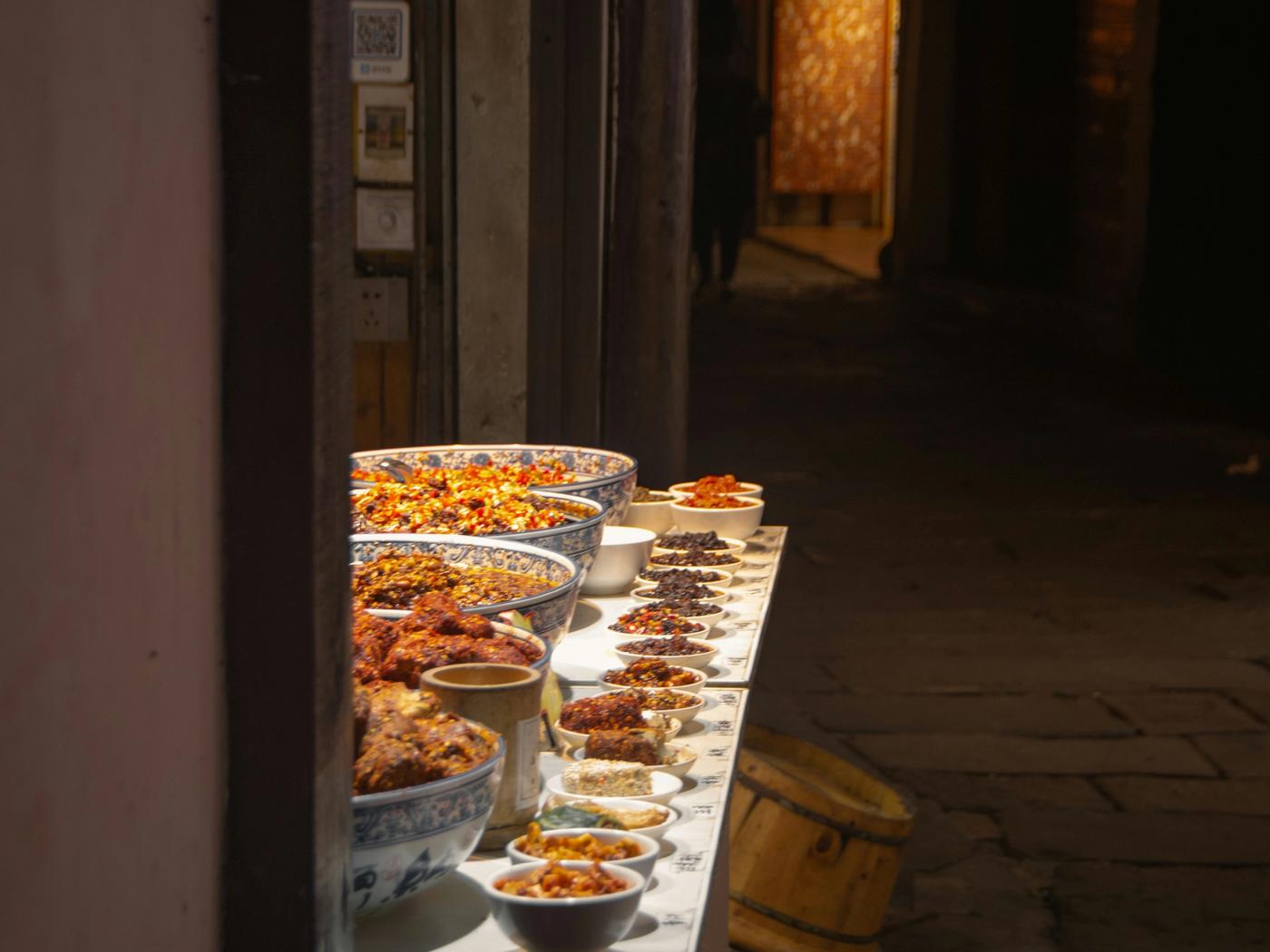
Ciqikou Ancient Town is Chongqing's most-visited old town, and the honest answer to "is it worth it?" is that it depends entirely on when you go and which streets you walk. On a holiday afternoon the main street is a crush of identical skewers, small-commodity stalls and long mahua queues. On a weekday morning, or in the rain, the back lanes are a different place — mossy flagstones, locals playing cards in old teahouses, and mist drifting up from the Jialing River. Pick the right hours and the right lanes and it earns the trip; pick the wrong ones and it is like any commercialised old town in China.
Should you go? Match it to your trip
Whether Ciqikou is worth your time depends on what kind of visit you're planning:
- In Chongqing on a weekday — worth it. Arrive before 10 a.m., walk the backstreets first, then the main street.
- There on a holiday — skip the main street. Head straight for the back lanes and the riverfront, or go another day.
- Only one day in the city — worth it, paired with Zhazidong and Bai Mansion for a neat single-day loop.
- After an untouched, "original" old town — this isn't it. Go to Pianyan or Songji old towns instead.
- Showing visitors Chongqing street food — worth it, as one stop to graze the local specialities. Photographers do well here too: the back lanes at dawn and the riverbank at dusk are the productive windows.
Getting there
Metro is the easiest option: take Line 1 to Ciqikou Station and leave by Exit 1, then walk about 5 minutes to the main Jinbi Gate. From Jiaochangkou (Jiefangbei) it's roughly 30 minutes and ¥4, with Line 1 linking Jiefangbei, Daping and Shapingba.
Several buses stop at Ciqikou — the 202, 220, 224, 237, 261, 467, 503, 808 among them. The 503 became a minor sightseeing hit in 2025: for ¥2 it threads together Ciqikou, Liziba and Chaotianmen. A taxi runs about ¥30–40 from Jiefangbei or ¥15–20 from the Shapingba shopping district. If you're driving, the lots around the old town fill fast on holidays; it's usually less painful to park by Shapingba and switch to the metro.
Skip the main street — the back lanes are the real Ciqikou
Around nine in ten visitors only walk Zhengjie, the 500-metre main street running from Jinbi Gate down to the river, lined solidly with shops. Walk only that and Ciqikou really is interchangeable with any commercial old town. Three lanes reward turning off it:
- Houjie (Cixing Street): turn west off the middle of the main street and the crowd instantly halves. This is where residents still live — an old barber, a bamboo-weaver, a carpenter's workshop — and it runs down to the Jialing River.
- Baolun Temple lane: a stone stairway between old houses leads up to Baolun Temple, the oldest structure in Ciqikou, dating to the Southern and Northern Dynasties and tied to the legend of the exiled Ming emperor Jianwen. Entry is free, and the top gives you a view over the whole town.
- Hengjie: a narrow lane parallel to the main street that few visitors bother with. A handful of old teahouses here will sell you a covered bowl of gaiwan tea for ¥5 and let you sit all afternoon among locals playing cards — about the last fragment of "old Chongqing" in Ciqikou.
What to eat — and which Chen mahua is the real one
Mahua — fried dough twists — is the signature snack, and the main street has a dozen shops all trading on the surname "Chen," which is the single biggest source of confusion. The distinctions worth knowing:
- Chen Changyin (陈昌银), founded 1907 — the oldest, and the one carrying the "China Time-honored Brand" mark. Look for "陈昌银" on the sign.
- Chen Jianping (陈建平) — newer, with the longest queues; the line spilling into the street is usually this one. The taste isn't meaningfully different from Chen Changyin.
- Xia Ji (夏记) — newer again, well regarded, and far less crowded. If you'd rather not queue, this is the easy call; a bag runs about ¥15–25, the same as the others, and every shop lets you taste before you buy.
Beyond mahua, Ciqikou is the birthplace of maoxuewang, the spicy blood-curd stew — "Guzhen Maoxuewang" and "Lanyu Shiguang" on the main street both have a good reputation, around ¥30–40 a head. Look also for hand-cut sweet-potato suanlafen made in front of you, salt-and-pepper peanuts (one of the town's "three snack treasures" alongside maoxuewang and dried tofu skin), freshly grilled ciba glutinous-rice cakes rolled in soybean flour, and the handmade yogurt sold in bottles — a good thing to drink when your feet give out.
Combine it: Ciqikou + Zhazidong + Bai Mansion
These three sites all sit around Gele Mountain in Shapingba District, so they combine efficiently. The least-walking order runs farthest-first:
- 9:00 — Zhazidong first (Line 1 to Lieshimu, then bus 210, or a ~¥15 taxi). It runs 9:00–17:00 with last entry at 16:30, and needs a reservation via the "Hongyan Lianxian" WeChat account.
- 10:30 — Bai Mansion, about a 15-minute walk or a shuttle from Zhazidong; allow roughly an hour.
- 12:00 — bus 210 back to Ciqikou for lunch, then spend the afternoon on the back lanes, main street and riverfront. Budget about an hour each for Zhazidong and Bai Mansion and 2–3 hours for Ciqikou — half a day to a full day in total.
When to go by time of day
Crowds swing hard across the day. From 7:00 to 9:00 it's almost empty, the back-lane teahouses are just opening, and it's the best light for photos. It stays manageable until about 11:00, then the lunch peak fills the main street from 11:00 to 14:00. The worst crush is 14:00–17:00, when tour groups converge. After 17:00 the groups leave and the night-market stalls come out; lanterns light up by 19:00, and the atmosphere is good even though the main street stays busy until around 22:00. Rain thins the crowds considerably and gives you reflective flagstones to shoot.
The Chongqing 1949 show
The Jinbi Theatre in Ciqikou stages a large immersive production, Chongqing 1949, set around the city's 1949 liberation, with a rotating auditorium and heavy stage machinery as its draw. It runs about 90 minutes. It isn't essential, but it's worth considering if you're interested in the Red Crag history, want an indoor evening activity, or are travelling with older relatives who often connect with this period. Buy through platforms like Maoyan or Damai a day or two ahead.
Riverside photo spots
Walk the main street down to the Jialing River and you reach an open stretch of bank — not a formal attraction, but you can get down to the water. Three angles pay off: late-afternoon backlight around 5–6 p.m. (4–5 p.m. in winter) for the town in silhouette against the shining river; early-morning mist around 7–8 a.m. for an ink-wash look over the water; and a turn-and-shoot from the bank for the full town panorama with the stacked rooftops and Baolun Temple's spire in one frame. One caution: in flood season (July–August) the river can rise and submerge the bank, so watch your footing.
Where the name comes from
Ciqikou was originally called Baiyanchang, after nearby white rock faces, and had a market as far back as the Song dynasty. Early in the Ming, the exiled emperor Jianwen is said to have become a monk here, and the town was renamed Longyin. In the early Qing it became a porcelain shipping port — the Jialing River made it an easy transit point — and took the name Ciqikou. Note it's written 磁, not 瓷: here 磁 is an old interchangeable form of 瓷 ("porcelain"), and the official name has always used 磁器口.
Mistakes to avoid
- Don't buy mahua at the first shop on the main street — walk 50 metres in and the same twists are ¥5 cheaper.
- Skip the "viral" bamboo-tube milk tea at ¥35–45 a cup — it has nothing to do with Ciqikou and shows up in every old town in the country.
- Don't eat a sit-down meal on the main street, where prices are inflated. Walk to Lailong Lane or Hengjie for local diners at around ¥20 a head.
- Don't take the main street on a public holiday — the crush is brutal.
- Don't buy "antiques" — the coins and bowls on the stalls are all reproductions.
- Baolun Temple is free, but lighting incense costs extra — just walk past it if you'd rather not pay; no one pushes you.